

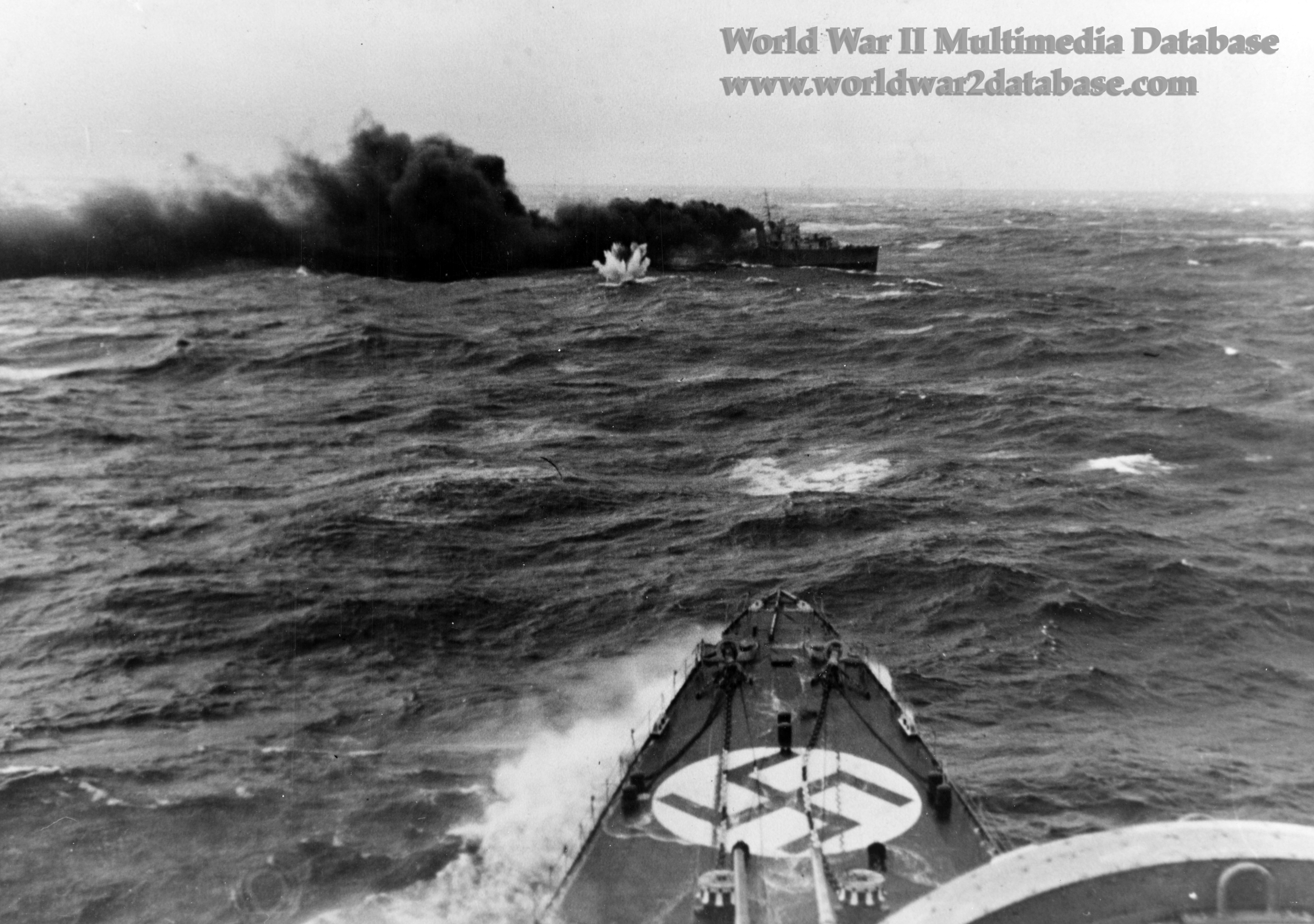
| “HMS Glowworm under attack and sinking in action with the German heavy cruiser Hipper, off the Norwegian coast. Note shell splash near Glowworm’s stern, and Nazi insignia on Hipper’s bow in foreground.
On April 8, 1940, HMS Glowworm was proceeding alone in heavy weather towards a rendezvous in West Fjord, Norway, when she met and engaged two enemy destroyers, scoring at least one hit on them. The enemy broke off the action and headed north to lead Glowworm on to his supporting forces. The Commanding Officer, Lieutenant Commander Gerard Broadmead Roope (March 13, 1905 – April 8, 1940), whilst correctly appreciating the enemy’s intentions, at once gave chase. The German heavy cruiser, Admiral Hipper, was sighted closing the Glowworm at high speed, and an enemy report was sent, which was received by HMS Renown. Because of the heavy sea, the Glowworm could not shadow the enemy, and Lieutenant Commander Rope therefore decided to attack with torpedoes and then to close in order to inflict as much damage as possible. Five torpedoes were fired and later the remaining five, but without success. The Glowworm was badly hit; one gun was out of action and her speed much reduced, but with the other three guns still firing, she closed and rammed the Admiral Hipper. As the Glowworm drew away, she opened fire again and scored one hit at a range of 400 yards. The Glowworm, badly stove in forward and riddled with enemy fire, heeled over to starboard, and Lieutenant Commander Roope gave the order to abandon her. Shortly after she capsized and sank. The Admiral Hipper hove to for at least an hour picking up survivors, but the loss of life was heavy, only 31 out of the Glowworm’s complement of 149 being saved. Testimony by Glowworm survivors only emerged after they were liberated from German Prisoner-of-War camps. Amongst them was the only surviving officer, Lieutenant Robert Archibald Ramsay (October 1897 – May 7, 1970), who confirmed the details of the action. Ramsay confirmed that Glowworm made smoke so as to obscure her position from the Hipper’s 8-inch (203 millimeter) guns, but to no avail. Ramsay also stated that, while many considered the ramming of Hipper to be a deliberate action, the destroyer’s steering was damaged, and that the turn towards Hipper and actual ramming may have been accidental. Either way, Glowworm struck the enemy cruiser and gouged open several holes along a 100 feet of her starboard side. The cruiser’s starboard torpedo mounting was destroyed, and one German sailor was knocked overboard and drowned. The damage to Glowworm, however, was mortal as her stern was broken off, and as she settled in the water, her boilers exploded, and she sank quickly with her battle ensign still flying. The entire action, from the sighting of the German destroyers to Glowworm’s sinking, lasted just over 3 hours. Hipper’s crew photographed the survivors through their gun sights. The actions of the Commanding Officer of Hipper, Captain Helmuth Heye (August 9, 1895 – November 10, 1970), require special mention as despite the damage to his ship – the cruiser was taking on water through the damaged starboard side – and that he was uncertain as to the location of other British units, he stopped his vessel downwind to allow the Glowworm’s survivors to drift down toward his ship where they were rescued. Lieutenant Commander Roope was known to have survived the sinking of his ship but was exhausted and unable to climb the ropes and ladders hung over the side of Hipper and subsequently drowned. Heye also later sent a message to the British Government, via the International Red Cross, giving a statement of Glowworm’s last action and that her commanding officer was worthy of high praise for engaging a much superior ship in close action. His statement, and those of Lieutenant Ramsay and other Glowworm survivors, earned Roope a posthumous Victoria Cross; despite it not being awarded until 1945, it was technically the 1st Victoria Cross of World War II.” Out of a total crew of 149, only 31 survived. The survivors spent the rest of the war as Prisoners of War. This image appeared in the May 13, 1940, issue of LIFE Magazine. |
|
| Image Filename | wwii2430.jpg |
| Image Size | 5681×3997 |
| Image Dimensions | 7.7 MB |
| Photographer | |
| Photographer Title | Kriegsmarine |
| Caption Author | Jason McDonald |
| Date Photographed | April 8, 1940 |
| Location | |
| City | |
| State or Province | |
| Country | Norway |
| Archive | Naval History and Heritage Command |
| Record Number | NH 71235 |
| Status | Caption ©2026 MFA Productions LLC Please Do Not Duplicate or Distribute Without Permission; Image in the Public Domain |

Author of the World War II Multimedia Database