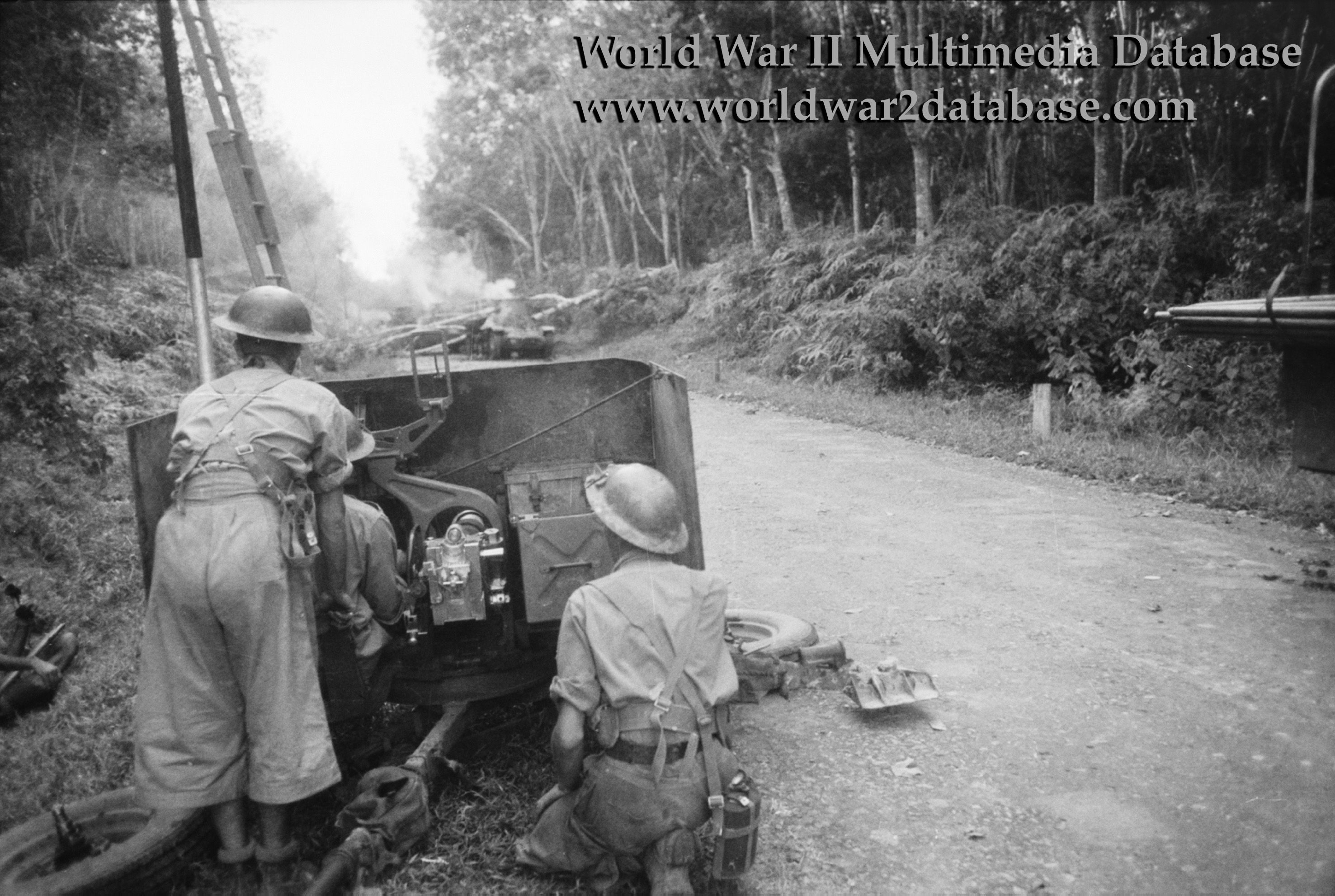
| Original caption: “An Australian 2-pounder anti-tank gun of the 2/4th Australian Anti-Tank Regiment, commanded by Sergeant Charles Parsons, left, firing on Japanese Type 95 Ha-Gō tanks as they try to pass trees felled across the Muar – Parit Sulong Road, near Bakri in Malaya, January 18, 1942. Nine tanks were destroyed by two 2-pounders in this engagement, part of the Battle of Muar, which took place around the Gemensah bridge and the Muar River in Johore. It was the last major engagement of the [Malayan] Campaign.”
Sergeant Charles J. “Charlie” Parsons (May 27, 1916 – September 14, 1981) of the 4th Anti-Tank Regiment directs an Ordnance QF 2-pounder 40mm (1.57 inch) anti-tank gun against Type 95 Ha-Gō light tanks of the Imperial Japanese Army 14th Tank Regiment under Captain Shigeo Gotanda (??? – January 18, 1942). Five tanks led the assault, forced to keep to the road by the hill’s angle. The 2-pounders waited until they were close to fire and destroyed all five tanks, and then four supporting ones that followed. Australian infantry from the 2/29th Battalion assisted in killing the crews as they bailed from the burning tanks. Lance Sergeant Kenneth I. Harrison (August 25, 1918 – July 28, 1982), the other experienced gun captain at the Muar-Parit Sulong Road, recorded his experiences of the battle in his memoirs. Harrison and Parsons, the only crews with battle experience, were detailed to take up positions against the oncoming Japanese armor. Harrison wrote, “There were undoubtedly dozens of crews who would have done just as well as we if given the chance, but we were the only crews with battle experience [at the recent Battle of Gemas], slight though it was. I have since had reason to be grateful for this decision, for it gave us the honor of being the only men in Malaya to fight at both Gemas and Muar, where, from the Australian Imperial Force (AIF) point of view, the two main battles of the Malayan campaign were fought.” Two other gun crews joined them despite having no combat experience. Harrison wrote, “[We] took up a position on the side of the road opposite Charlie Parsons’s gun. Early that morning, a force of six Japanese tanks had clattered down the road in single file and had made a determined and courageous attempt to break through our lines. Sergeant Clarrie Thornton (April 10, 1918 – March 24, 1998), whose gun was out of sight round a bend, immediately engaged them and succeeded in hitting the first, third, and fourth tanks. Despite the shells that crashed into them, the tanks clattered on and lurched past Thornton’s gun; smoke poured from them, indicating that they had been badly hit. Although they were only a bare sixty yards from the advanced Japanese infantry, Clarrie and his crew dragged their gun onto the road, swung it round, and fired into the back of the retreating tanks. During this action, Clarrie Thornton was severely wounded in the hip by a Japanese sniper, but he refused to leave his gun. “By now, the leading tanks had turned the bend and were within range of the rear gun. The front tank had that within its womb which it did not like, and one can only guess at the scene of carnage and destruction from the shells that had hurtled and ricocheted so savagely around inside the cabin. But there existed at least one will and spirit within the tank, and still it came doggedly on, leading the tank column but capable now only of walking pace as it neared the rear gun. Fortunately, it never appeared to sight the rear anti-tank gun, which was in a slight hollow on the side of the road. Or possibly only the driver still lived. It was early morning, and a mist hung over the road.” “Only Charlie Parsons will ever really know why the tanks were allowed to get so close to the rear gun. It was either amazing coolness on his part, or he had momentarily forgotten that he had given the fire order. Whatever the reason, Ken Daniel, the gun layer, waited tensely for a fire order until the tanks were less than forty yards away. Looking behind him expectantly, he was somewhat startled to see Charlie dancing up and down with excitement. As the tanks were now so close that he had three in his sights at the same time, Ken was vastly relieved to hear Charlie shout, ‘Fire!'” “Now, only a cool head and deadly accuracy could save them—there could be no second chances here. But Ken Daniel was equal to the occasion. His opening shot tore its way into the front tank, which jarred to an abrupt halt while the others piled up behind it on the narrow road. Ken then destroyed the first four tanks, one after another. The shells crashed savagely, and the metal turrets clanged open as the crews attempted to escape from their smoking hearse, but there was an infantryman with a Vickers gun on the bank above them, and he sat there and coolly scythed them down as they appeared. It was not long before the last two tanks suffered the same fate as the others.” “The entire action was a masterly piece of coordination. Not only had the 2/29th heavily machine-gunned any survivors from the tanks, but their mortar crews dropped shell after shell at very close range, which may have accounted for the fifth tank. Fortunately, the tank crews had been taken completely by surprise, and their fire was brief, erratic, and ineffectual. It was just as well, for one accurate shot would have been enough to put Charlie’s gun out of action. Nevertheless, it was a gallant attempt, and had they broken through, they might not only have caused heavy loss of life in the rear, but also prevented reinforcements reaching us. Clarrie Thornton’s courage in remaining by his gun was fittingly rewarded later in the morning when three more tanks made a determined effort to break through. In a fiery action, Clarrie and his crew destroyed the tanks before they could get within a hundred yards of our lines. Then, and then only, would Clarrie consent to leave and get his hip treated. Gotanda, suffering from “victory disease,” had refused a request from his tank crews to wait for supporting infantry. As his men bailed out, they were cut down by Australian riflemen accompanying the anti-tank guns. This Allied victory was short-lived, as the commonwealth formations, shocked by a lack of training and equipment and constantly bombed from the air, collapsed, as many officers were killed in action. The Japanese infiltrated behind the Indian units’ lines, and, lacking the will to continue the fight, they fell back. But the Australians were trained, equipped, and combat-ready, and destroyed a Japanese company in Bakri. But it didn’t make any difference – while the Australians were focused on Bakri, the Japanese were surrounding the Allies. They had to fight their way out, while carrying out many wounded, making this victory, which was hailed around the western world, the last major engagement before the Allies fell back on Singapore itself. A resident of Moonee Ponds, Victoria, Charles J. Parsons enlisted on December 16, 1940, in his hometown of his father, Royal Park, Riddell, Victoria. A drover (sheep driver) before the war, he was made a Sergeant a few days after enlisting. He fractured his jaw on January 15, 1941. He sailed to Singapore on SS Zelandia in June 1941, but was “admonished” for “conduct to prejudice good order” on September 27, 1941. He was listed as Missing in Action on April 6, 1942, and as a Prisoner of War on September 15, 1943. He embarked at Singapore on October 5, 1945, and returned to Melbourne on October 24, and received back pay. Parsons received the Distinguished Conduct Medal on March 8, 1946. Posted in the Commonwealth of Australia Gazette on September 25, 1946. Posted in the London Gazette on October 1, 1946. Honorably discharged on June 14, 1946. His Distinguished Conduct Medal citation read: “On January 14 and 15, 1942, during the operations at Gemas, Sergeant Parsons performed valuable work in the supply of ammunition under fire and in the destruction of a gun in difficult circumstances, after he had made every possible effort to withdraw it intact. On January 20, at Muar, Sergeant Parsons engaged four enemy tanks, allowing them to approach within thirty yards before opening fire, destroying three. He then went forward and single-handedly destroyed the fourth tank with grenades. On January 21, Sergeant Persons showed similar courage and initiative in the successful extrication of his detachment after a roadblock had cut it off.” Parsons married Grace Smith (later Grace Callander, 1922 – August 13, 1997) on January 12, 1946, and they were divorced by 1962. They do not appear to have any children. Parsons’s loader, Gunner Leonard E. “Lenny” Coutts (February 9, 1922 – May 3, 1999), enlisted at Royal Park, Riddell, Victoria, on May 31, 1941. A week later, on June 7, he was granted a week’s leave without pay. He rejoined the 2nd Field Infantry Regiment on June 21, 1941. On July 23, he was posted to the 4th Tank Regiment. His last leave before the war was November 13-16, 1941. He was listed as Missing in Action on January 27, 1942, and declared a Prisoner of War on September 15, 1943. Coutts was held in the Fukuoka Prisoner of War Camp in Japan. Recovered on December 12, 1945, he was honorably discharged on January 1, 1946. During captivity, his forearm was injured. While he was in the hospital in 1959, his medals were stolen. Parson’s aimer, Lance Bombardier Kenneth L. Daniel (July 26, 1906 – May 10, 1990), enlisted at Royal Park on July 15, 1940. He was initially assigned to the 1st Light Anti-Aircraft Artillery Regiment, and then the 3rd on January 1, 1941. He transferred to the 4th Anti-Tank Regiment on April 3, 1941. Daniel embarked on the steamship Zelandia on May 23, 1941, and arrived in Singapore on June 18, 1941. He missed the Battle of Gemas, but was chosen for the Battle of the Muar River to replace battle casualties. Daniel was a close friend and tennis partners with Harrison and was chosen on that basis to join Parsons’s crew. He was able to return to Singapore after the battle and surrendered with the rest of the garrison on February 15, 1942. Initially, he was incarcerated at Changi Prisoner of War Camp, where he was debilitated by his journey back to Singapore from the Malayan peninsula and had a severe foot infection. When Harrison was captured by the Japanese and incarcerated at Changi in late February 1942, Daniel was so glad to see him that he got out of bed and embraced him. He was diagnosed with beri-beri (B1 vitamin deficiency) on September 9, 1942. He was rescued from Kranji Prisoner of War Camp on September 5, 1945. On September 13, 1945, he embarked on the Australian hospital ship Manunda and evacuated to Morotai. He returned to Australia on October 11, 1945, and was honorably discharged on February 18, 1946. He never fully recovered from his incarceration. Imperial Japanese Army Colonel Masanobu Tsuji (October 11, 1902 – disappeared c. 1961), a war criminal protected by the United States Central Intelligence Agency, hailed Gotanda’s warrior spirit in his own post-war memoir. In 1942, Tokyo radio broadcast an elegy for Gotanda, proclaiming his sacrifice a noble death for the Emperor. These kinds of proclamations began to lay the foundation for the Imperial Japanese Army’s death cult practices later in the war. |
|
| Image Filename | wwii2433.jpg |
| Image Size | 1.2 MB |
| Image Dimensions | 1982×2953 |
| Photographer | |
| Photographer Title | |
| Caption Author | Jason McDonald |
| Date Photographed | January 18, 1942 |
| Location | Muar – Parit Sulong Road |
| City | Maur |
| State or Province | Johore |
| Country | Malaya |
| Archive | Imperial War Museum |
| Record Number | MH 30848 |
| Status | Caption ©2026 MFA Productions LLC Please Do Not Duplicate or Distribute Without Permission |

July 26, 2026